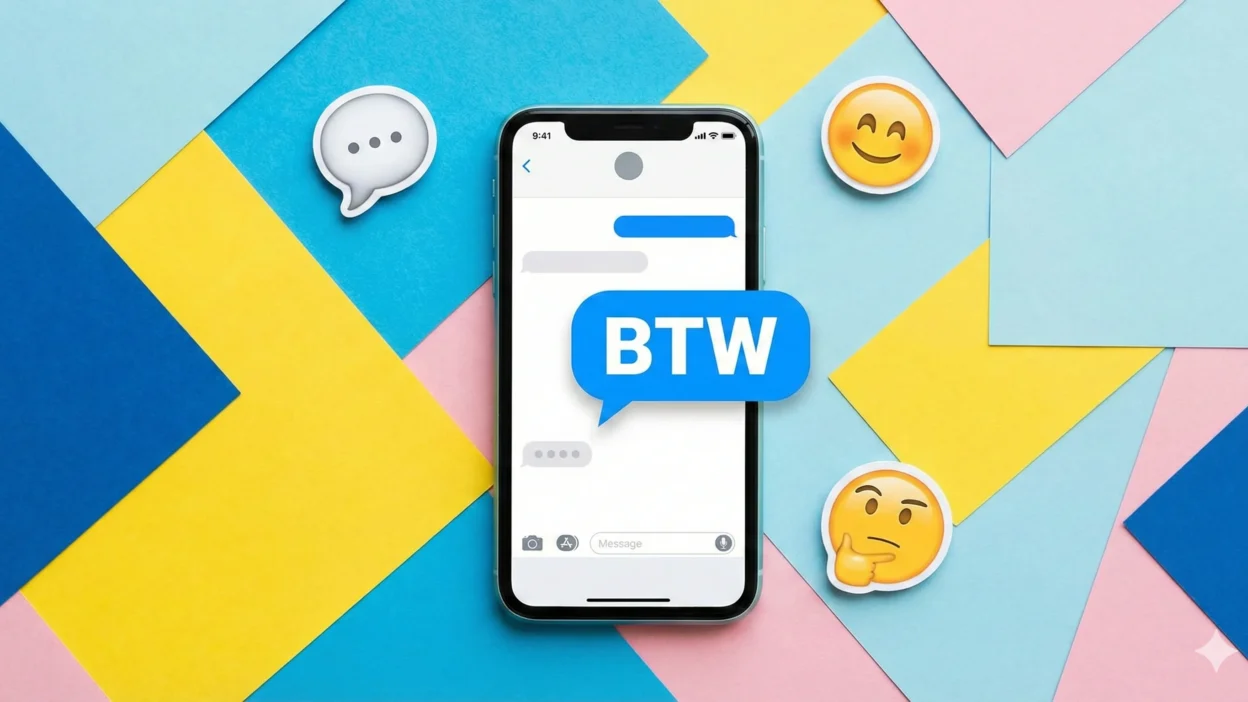
I’ll never forget the first time I saw “BTW” pop up in a group chat. My friend had written, “The party starts at 8. BTW, I’m bringing a plus-one.” I stared at my screen, confused. Was it an acronym for some new band? A typo? I felt a little out of the loop, scrambling to figure it out without having to ask and reveal my slang ignorance. If you’ve ever been in that same boat, don’t worry—you’re about to become an expert.
BTW means “By The Way.” It’s a casual and friendly way to introduce a new, often related, piece of information into a conversation or to gently shift the topic.
🧠 What Does BTW Mean in Text?
In the fast-paced world of digital communication, BTW is a cornerstone of texting shorthand. It’s an initialism, meaning each letter is pronounced individually (B-T-W), and it stands for the common English phrase “By The Way.”
Its primary function is to act as a conversational pivot. Think of it as a verbal nudge, a way to smoothly add an afterthought, an extra piece of context, or a slightly related question without derailing the entire conversation. It keeps the chat flowing naturally, just like it would in a face-to-face discussion.
Example: “Loved the movie! BTW, have you seen the sequel yet?”
In short: BTW = By The Way = A casual transition to add new info.
📱 Where Is BTW Commonly Used?
BTW is one of the most versatile and universally understood pieces of text slang. You’ll find it thriving in virtually every corner of digital communication. Its tone is inherently casual and social-media–friendly.
- Text Messaging (SMS/iMessage/WhatsApp): Its original and most common home. Perfect for quick, informal chats with friends and family. 💬
- Social Media Platforms (Instagram, Twitter/X, Facebook): Used in comments, direct messages (DMs), and captions to add quick thoughts. 👍
- Online Gaming & Forums (Discord, Reddit): Gamers and forum users use it to quickly add strategic points or off-topic questions. 🎮
- Email (Informal Only): While generally avoided in formal emails, it’s perfectly acceptable in quick, internal messages to colleagues you have a friendly rapport with. ✉️
- Slack & Microsoft Teams (Workplace Chat): Commonly used in informal team channels for adding quick, related notes or questions. 💼
💬 Examples of BTW in Conversation
Seeing BTW in action is the best way to understand its flow. Here are some realistic chat examples.
Example 1: Making Plans
A: Are we still meeting for coffee tomorrow?
B: Yeah, 3 PM works for me. BTW, the new café on Main Street just opened. Want to try it?
Example 2: Sharing News
A: I just finished that project for work. So relieved!
B: That’s awesome! You should celebrate. BTW, I heard Sarah got the promotion she wanted.
Example 3: Asking a Related Question
A: I’m heading to the grocery store. Do you need anything?
B: Could you grab some milk? BTW, what are we doing for dinner tonight?
Example 4: Adding Context
A: I can’t believe Jake is moving to Spain.
B: I know, it’s mistaken! BTW, he said he got a job as a English teacher.
Example 5: In a Group Chat
Alex: The hike this weekend is at 9 AM at the north trailhead.
Sam: Perfect, I’ll be there. BTW, the weather app says it might rain, so bring a jacket.
Example 6: A Slightly Flirty Use
A: That was a really fun date last night 😊
B: I had a great time too. BTW, you have a really amazing laugh.
Example 7: A Work-Related Chat (Informal)
Colleague A: Can you send me the Q3 report when you get a chance?
Colleague B: Sure thing, it’s in your inbox now. BTW, the meeting with marketing got moved to 2 PM.
🕓 When to Use and When Not to Use BTW
Understanding the context is key to using BTW correctly. It’s a fantastic tool, but not for every situation.
✅ When to Use BTW
- In casual chats with friends, family, and peers.
- On social media in comments and DMs.
- To add a relevant piece of information without starting a new conversation thread.
- To gently change the subject in a friendly manner.
- In quick, informal internal messages at work with teammates you know well.
❌ When NOT to Use BTW
- In formal emails to clients, superiors, or for official business. It can come across as unprofessional.
- When delivering serious or bad news. Using BTW can seem dismissive or insensitive.
- In urgent messages where clarity is paramount. Spell it out to avoid any confusion.
- In academic or legal writing. Always use the full phrase “by the way” or a more formal transition.
Contextual Use Table
| Context | Example Phrase | Why It Works (or Doesn’t) |
|---|---|---|
| Friend Chat | “The party’s at my place. BTW, it’s a potluck!” | Casual & friendly; perfect for the context. |
| Work Chat (Informal) | “Sent the draft. BTW, the client loved the initial concept.” | Acceptable with close colleagues; adds a quick, positive note. |
| Formal Email | “Please find the attached report. By the way, I have scheduled a follow-up meeting.” | “By the way” is better, but a formal transition like “Additionally,” or “For your reference,” is strongest. |
🔄 Similar Slang Words or Alternatives
BTW is part of a family of conversational transition words in text slang. Here’s a quick guide to its cousins.
| Slang | Meaning | When to Use It |
|---|---|---|
| FYI | For Your Information | To present a fact or piece of info the other person should know, often without expecting a direct response. More neutral than BTW. |
| IMO/IMHO | In My Opinion / In My Humble Opinion | To preface a personal opinion or thought, often softening the delivery. |
| IDK | I Don’t Know | A quick, casual way to express uncertainty or lack of knowledge. |
| TBH | To Be Honest | Used to introduce a frank, honest, or sometimes critical opinion. |
| OMW | On My Way | A quick status update to inform someone you’re en route. |
| FWIW | For What It’s Worth | A humble way to offer an opinion or suggestion, implying it may or may not be useful. |
🎯 The Subtle Art of the BTW Tone
The beauty of BTW lies in its subtlety. While it’s generally neutral, its tone can be shaped by the message that follows it.
- The Informative BTW: This is its most common use. It simply adds a relevant fact. “Great presentation today. BTW, you left your notebook in the conference room.”
- The Gossipy BTW: This one lowers the virtual voice and adds a hint of secrecy or excitement. “I can’t believe they’re dating. BTW, I saw them holding hands yesterday.” 🤫
- The Flirty BTW: As seen in the examples, it can be used to slip in a compliment smoothly. “Had a great time tonight. BTW, you looked really beautiful in that dress.” 😉
- The “I Almost Forgot” BTW: This acts as a mental sticky note. “Thanks for grabbing the groceries. BTW, don’t forget we have a doctor’s appointment tomorrow.”
📚 A Brief History of BTW in Digital Culture
BTW didn’t originate with Gen Z. Its roots are deep in early digital communication. It was a staple of IRC (Internet Relay Chat) and early AOL Instant Messenger (AIM) conversations in the 1990s and early 2000s. In an era of dial-up internet and character limits, efficiency was king. Acronyms like BTW, BRB (Be Right Back), and LOL (Laughing Out Loud) allowed users to communicate complex ideas quickly, saving precious time and keystrokes. Its survival and continued dominance prove its fundamental usefulness in our daily digital interactions.
🤔 Is BTW Rude?
This is a common question, and the answer is: it depends entirely on context.
In a casual setting with friends, it’s not rude at all—it’s completely normal. The potential for rudeness arises in more formal or sensitive situations.
- Potentially Rude: “Your report has several critical errors. BTW, we need to talk about your performance.” (This minimizes the seriousness of the second point.)
- Not Rude: “Let’s connect about the project timeline. BTW, I loved the design mockups you shared!” (This adds a positive, related note.)
The key is to gauge the formality of the relationship and the gravity of the topic. When in doubt, especially in professional settings, spell it out.
🔍 How BTW Compares to FYI
People often confuse BTW and FYI, but they serve distinct purposes.
- BTW (By The Way): Is conversational and additive. It’s used within the flow of a dialogue to introduce something new, often related to the previous topic. It expects the conversation to continue.
- FYI (For Your Information): Is declarative and informative. It’s used to present a standalone piece of information for the other person’s awareness, often without an expectation of a direct response. It can sometimes feel slightly more formal or detached than BTW.
Example Comparison:
- BTW: “I’m heading to the bank. BTW, did you pay the electricity bill?” (This is part of a conversation).
- FYI: “FYI, the electricity bill is due tomorrow.” (This is a piece of information being passed along).
💡 Pro-Tips for Using BTW Like a Native
- Punctuation is Flexible: You can write it as
BTW,btw, orBtw. The lowercase version is often perceived as even more casual. - Comma After BTW: While often omitted in ultra-casual texts, using a comma after BTW can improve clarity. “Loved the gift btw you’re the best” can be slightly confusing at a glance. “Loved the gift, btw, you’re the best” is clearer.
- Don’t Overuse It: If every other sentence in your text starts with BTW, it can make you sound scattered or forgetful. Use it sparingly for maximum effect.
❓ FAQs About BTW
What does BTW stand for?
BTW stands for “By The Way.”
Is BTW formal or informal?
BTW is overwhelmingly informal. It is best used in casual conversations with friends, family, and close colleagues. Avoid it in formal reports, emails to clients, or official documents.
Can BTW be used in a flirty way?
Absolutely! BTW can be a perfect, low-pressure tool for flirting. It allows you to slide a compliment or a personal question into the conversation without making it the main focus, which can feel less intense. For example: “That was a fun night. BTW, I haven’t been able to stop thinking about you.”
What are some synonyms for BTW?
In spoken English, you might say “incidentally,” “on a related note,” or “oh, I meant to ask.” In text slang, FYI (For Your Information) is a close cousin, though it serves a slightly different, more informational purpose.
How do you pronounce BTW?
You pronounce it by saying each letter individually: “B-T-W.”
Is BTW outdated?
Not at all! While it’s an older piece of internet slang, BTW remains extremely popular and widely used across all age groups. It’s a classic for a reason.
✅ Conclusion
So, the next time you see BTW light up your screen, you’ll know exactly what to do. It’s not a complex code or a mysterious Gen Z invention—it’s simply a digital shortcut for the timeless phrase “by the way.” It’s the text-speak version of a friendly tap on the shoulder, a way to keep our conversations flowing smoothly and naturally, even through a screen.
Now that you’re in the know, feel free to sprinkle it into your own messages. BTW, you’re going to use it perfectly. 😉

Tove Jansson is a writer and dream interpreter with a deep fascination for the symbolic world of the subconscious. She explores how everyday experiences manifest in dreams, blending creativity with spiritual insights. Tove believes that every dream carries a hidden message meant to guide personal growth and self-discovery.