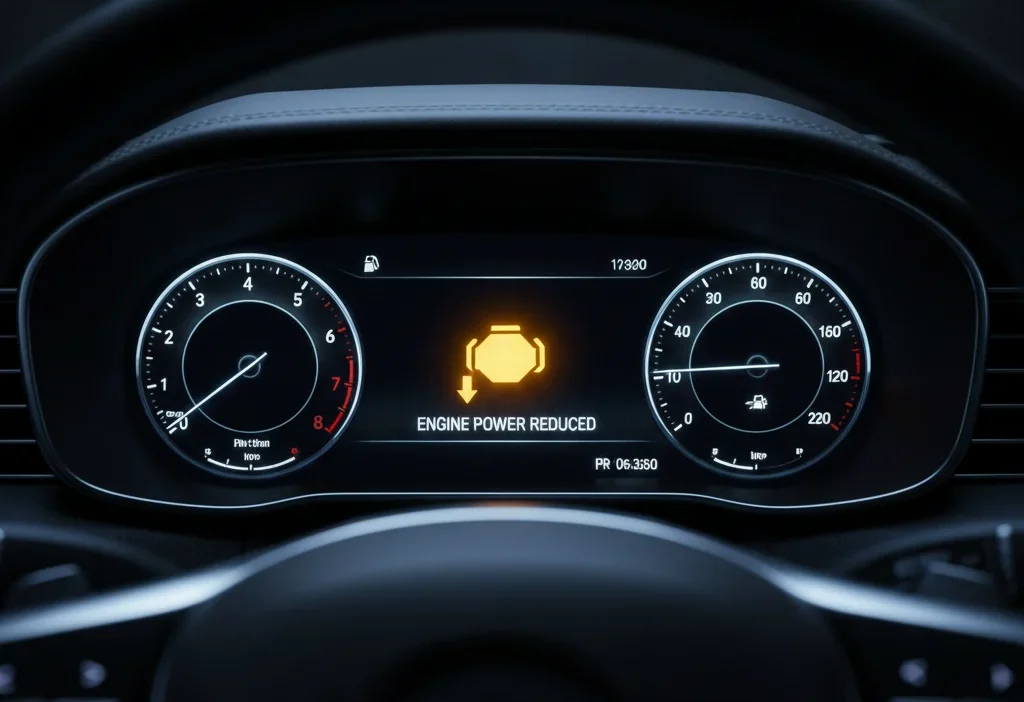
The first time I saw the message “Engine Power Reduced” pop up on my car dashboard, I froze. One moment I was cruising comfortably, and the next, my car felt weaker, slower, and completely unresponsive. If you’ve just seen this warning, you’re probably confused too — is the engine damaged? Is it safe to drive? Is this a minor issue or something serious?
Don’t worry — you’re not alone. This warning is common in modern vehicles, especially those with advanced safety systems.
“Engine Power Reduced” means your car has automatically lowered its power output to protect the engine from potential damage.
This safety mode — often called limp mode — limits speed and acceleration until the problem is fixed.
What Does “Engine Power Reduced” Mean in Cars?
The message “Engine Power Reduced” appears when your vehicle’s computer (ECU) detects a problem that could damage the engine. To protect itself, the car reduces power, limits acceleration, and sometimes restricts speed.
This is similar to your phone going into low-power mode — but for your engine.
What It Means in Simple Words:
Your car is warning you:
➡️ “Something’s wrong. I’m reducing power so I don’t get damaged.”
Example:
You may notice:
- Slow acceleration
- Car won’t go above 40–60 mph
- Rough idling
- Warning lights like Check Engine or Traction Control
In short: “Engine Power Reduced” = Protection Mode = Your engine is preventing damage.
: Common Reasons Why “Engine Power Reduced” Appears
Here are the most frequent causes:
🔧 1. Faulty Throttle Body
When the throttle body gets dirty or fails, the ECU reduces power to prevent uncontrolled acceleration.
🔌 2. Bad Sensors (O2, MAF, MAP)
If your car gets incorrect air or oxygen readings, it can’t maintain proper fuel balance.
🪫 3. Low Battery Voltage or Weak Alternator
Insufficient power confuses the vehicle’s sensors.
⛽ 4. Fuel System Problems
Clogged fuel pumps, injectors, or filters restrict engine performance.
🌡️ 5. Engine Overheating
To avoid severe damage, the ECU cuts engine power.
🧰 6. Transmission Issues
If the transmission slips or overheats, the car enters limp mode.
🧯 7. Electrical Wiring Problems
Loose or corroded wiring disrupts communication between engine components.
What Happens to Your Car When Engine Power is Reduced?
Once this warning activates, you may notice:
- 🚗 Slow or weak acceleration
- 🛑 Vehicle won’t exceed a set speed limit
- ⚠️ Check Engine Light might turn on
- 🔄 Transmission may feel stuck
- ⛽ Rough engine performance
This mode is designed for safety, not punishment. It ensures your car stays drivable long enough for repair.
Is It Safe to Drive With “Engine Power Reduced”?
The short answer: Only for a short distance.
If the car enters limp mode:
- Avoid high speeds
- Avoid highways
- Drive directly to a mechanic
- If the car shakes or overheats → Stop Immediately
It’s safer than breaking down — but not safe to ignore.
How to Fix “Engine Power Reduced” (Step-by-Step)
✅ Step 1: Restart The Car
Sometimes it’s a temporary sensor glitch.
✅ Step 2: Check the Air Filter
A clogged filter disrupts air intake.
✅ Step 3: Inspect Battery & Alternator
Weak voltage is a common cause.
✅ Step 4: Clean the Throttle Body
Carbon buildup is extremely common.
✅ Step 5: Use an OBD2 Scanner
Scan for error codes to locate the exact problem.
❗ If you see codes like:
- P0120–P0229 → Throttle issues
- P0100–P0104 → MAF sensor
- P0300 → Misfire
- P2135 → Accelerator pedal issue
These directly trigger reduced engine power.
Is “Engine Power Reduced” Expensive to Fix?
Here are average repair costs:
| Cause | Estimated Cost |
|---|---|
| Throttle body replacement | $150–$450 |
| MAF sensor | $120–$300 |
| Oxygen sensor | $100–$250 |
| Electrical wiring | $50–$200 |
| Battery/alternator | $90–$400 |
| Fuel system cleaning | $80–$150 |
Some issues are cheap, others more serious. Diagnosis is key.
How to Prevent “Engine Power Reduced” in the Future
Follow these simple maintenance tips:
- 🧽 Clean throttle body every 20,000 miles
- 🪫 Replace battery every 3–4 years
- ⛽ Use higher-quality fuel
- 🧵 Check wiring during routine service
- 🔧 Scan vehicle regularly
- 🌫️ Replace air filter yearly
Small maintenance = Big protection.
Symptoms That Usually Show Before “Engine Power Reduced”
Most drivers miss early warning signs:
- Jerky acceleration
- Car feels heavier
- RPM fluctuates
- Unusual engine sounds
- Gas mileage drops
- Check engine light blinking
Catch these early → Avoid limp mode later.
“Engine Power Reduced” vs. “Reduced Engine Performance”
Some cars display similar but different warnings.
| Warning | Meaning |
|---|---|
| Engine Power Reduced | Severe protection mode. Major issue detected. |
| Reduced Engine Performance | Mild performance drop. Often sensor-related. |
| Service Traction Control + Power Reduced | Shared sensor failure affecting both systems. |
Example Situations Where Cars Enter Reduced Power Mode
📌 Scenario 1
You accelerate to merge on the highway…
Suddenly the car slows, and “Engine Power Reduced” flashes.
Your throttle sensor has likely failed.
📌 Scenario 2
Car feels slow in cold weather…
Moisture affects the MAF sensor.
📌 Scenario 3
You hit a speed bump hard…
A loose wire triggers safety mode.
Real-life. Common. Fixable.
FAQs About “Engine Power Reduced”
1. Can I ignore this warning?
No. It protects your engine from severe damage.
2. Can low fuel cause this?
Yes — sediment in an empty tank can clog fuel delivery.
3. Does restarting the car fix it?
Sometimes temporarily — but the underlying fault remains.
4. Can cold weather trigger it?
Yes. Sensors often malfunction in freezing temperatures.
5. Does every car have this feature?
Most modern cars (2008+) do.
Conclusion
The “Engine Power Reduced” warning is your car’s way of protecting itself from damage. While it can be alarming, it’s actually a smart safety feature. Whether the issue is a minor sensor glitch or a more serious engine component failure, fixing it early can prevent expensive repairs. Understanding the warning helps you react safely, avoid breakdowns, and keep your vehicle in good health.
Take it seriously, diagnose it quickly, and your car will be back to full power in no time 🚗💨.

Hiromi Kawakami is a contemporary dream analyst and spiritual writer who explores the intersection of everyday life and dream symbolism. Her approach blends gentle observation with mystical insight, guiding readers to understand the spiritual significance of their dreams. Hiromi encourages self-reflection through the subtle messages of the subconscious.