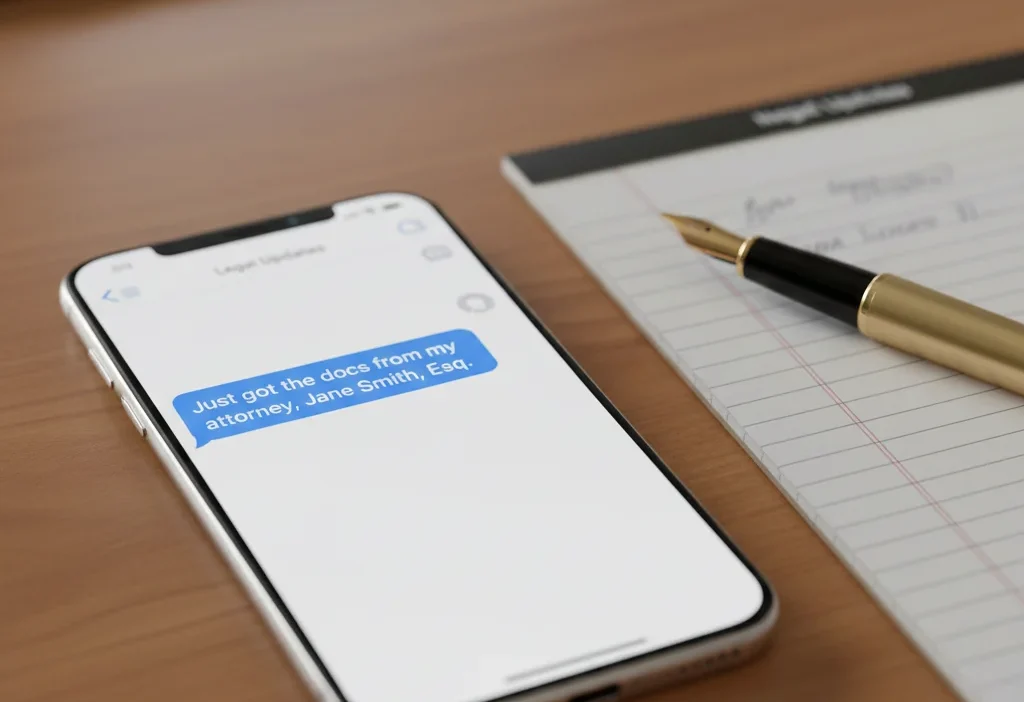
I was scrolling through a legal drama forum the other day, completely immersed in a fan theory, when I saw a comment that stopped me in my tracks: “Well, according to my source, John Doe, Esq., the precedent is clear.” My brain screeched to a halt. Esq.? Was that some new internet acronym I’d missed? Like “ESK” for “eternally seeking knowledge”? Or maybe a typo for “ESP”? I felt a pang of that familiar digital-age confusion—the feeling of being out of the loop. After a quick, slightly embarrassed search, I realized the truth: Esq. isn’t text slang at all. It’s a whole different world. If you’ve ever been puzzled by those three little letters, you’re in the right place.
Esq. means “Esquire.” It’s a formal, professional title used primarily in the United States to denote a licensed attorney. It’s a respectful way of addressing a lawyer without using “Mr.” or “Ms.”
🧠 What Does Esq. Mean in Text?
Let’s clear this up right away. While you might see “Esq.” in the signature line of an email or a professional social media profile like LinkedIn, it is not a piece of casual text slang like “FR” or “IMO.” Its usage is specific and formal.
The full form of Esq. is Esquire. Historically, this term had chivalric roots in England, referring to a candidate for knighthood or a member of the gentry. However, its meaning has evolved significantly, especially in American English. Today, in the United States, “Esquire” (abbreviated as Esq.) is a professional title for someone who has passed the bar exam and is licensed to practice law. It’s essentially a suffix that signifies “Attorney at Law.”
You would use it after a person’s full name, typically in written correspondence. For example:
- “Please direct all inquiries to Sarah Jones, Esq.“
- “The contract was reviewed by Michael Chen, Esq.“
In short: Esq. = Esquire = A title for a licensed lawyer.
📱 Where Is Esq. Commonly Used?
Given its formal nature, you won’t see “Esq.” tossed around in TikTok comments or casual gaming chats. Its habitat is strictly professional. Here’s where you’re most likely to encounter it:
- 📧 Professional Emails & Correspondence: This is the most common place. Lawyers often add “Esq.” to their email signatures.
- ⚖️ Legal Documents: Court filings, contracts, legal notices, and official letters frequently use this title to identify attorneys.
- 📇 Business Cards & Letterheads: It’s a standard part of a lawyer’s professional branding.
- 🔗 LinkedIn & Professional Profiles: On platforms like LinkedIn, you’ll often see it appended to a lawyer’s name in their headline or contact info.
- 🏢 Office Nameplates & Directories: Signifying the presence of a legal professional.
Tone & Context: Esq. is highly formal and professional. It is the opposite of casual or social-media-friendly slang. Using it correctly shows respect for the individual’s professional standing.
💬 Examples of Esq. in Conversation
Since “Esq.” isn’t used in back-and-forth texting the way slang is, these examples focus on realistic professional and formal written contexts.
- In an Email Signature:
- Eleanor Vance, Esq.
- Partner | Vance & Associates, LLP
- evance@vancelaw.com | (555) 123-4567
- On a Business Letter:
- The envelope is addressed to: Mr. David Lee, Esq., c/o Lee Legal Group, 123 Main Street.
- In a Legal Document:
- “COMES NOW, the plaintiff, by and through their counsel of record, Jennifer Cruz, Esq., and alleges as follows…”
- In a Professional Bio:
- “Prior to founding her firm, Maria Garcia, Esq., served as a federal prosecutor for ten years.”
- In a Formal Introduction:
- “I’d like to introduce you to our corporate counsel, Robert Smith, Esq. Robert, this is the CEO, Anna Kim.”
- On a Law Firm Website:
- “Our team of experienced litigators, including Thomas ‘Tommy’ Reed, Esq., is dedicated to defending your rights.”
- In a Client Communication:
- “Dear Client, Please be advised that all documents should be sent directly to Patricia Wong, Esq. at our downtown office.”
🕓 When to Use and When Not to Use Esq.
Understanding the context is crucial because misusing “Esq.” can come across as awkward or uninformed.
✅ When to Use Esq.
- In Written Correspondence to a Lawyer: When addressing a letter, email, or formal invitation to an attorney.
- In Legal Filings and Documents: When referring to an attorney involved in a case or contract.
- In Formal Introductions: When introducing a lawyer in a professional setting (e.g., a conference or meeting).
- On Professional Materials: When listing a lawyer’s name on a website, business card, or directory.
❌ When NOT to Use Esq.
- If You Are Not a Lawyer: You should not use “Esq.” after your own name. It’s a title bestowed by virtue of their profession, not a generic honorific.
- With Another Title: Do not use “Esq.” with “Mr.,” “Ms.,” “Dr.,” etc. It’s one or the other. You would say “Ms. Jane Doe” or “Jane Doe, Esq.,” but never “Ms. Jane Doe, Esq.”
- In Casual Conversation or Texting: It is far too formal for a text message or a casual chat. Simply use their name.
- For Someone Who Is Not a Licensed Attorney: The title is exclusive to the legal profession in the U.S.
Here’s a quick comparison table to make it crystal clear:
| Context | Example Phrase | Why It Works |
|---|---|---|
| Formal Letter to a Lawyer | “To: Benjamin Carter, Esq.“ | Professionally respectful and correct. |
| Casual Text to a Lawyer Friend | “Hey Ben, are we still on for lunch?” | Appropriately informal for a personal relationship. |
| Professional Email Signature | “Alex Rivera, Esq.\nSenior Associate” | Standard professional branding. |
| Formal Email to a Non-Lawyer | “Dear Dr. Evans,” or “Hello Mr. Chen,” | Uses the correct, relevant title for their profession. |
🔄 Similar Professional Titles or Alternatives
Since “Esq.” is a professional title, it’s helpful to see it alongside other common titles and designations. This table shows alternatives and how they compare.
| Title / Abbreviation | Meaning | When to Use |
|---|---|---|
| Esq. | Esquire (Licensed Attorney) | Suffix for a lawyer’s name in formal/professional contexts. |
| J.D. | Juris Doctor (Law Degree) | Signifies the person has earned a law degree but may not be practicing. Use after a name, e.g., “Jane Doe, J.D.” |
| JD | ||
| Attorney at Law | Licensed Attorney | A descriptive title, often used on letterheads and signs, e.g., “Jane Doe, Attorney at Law.” |
| Counsel | Legal Adviser | A term for a lawyer, often used in-house within a company (e.g., “Corporate Counsel”). |
| Dr. | Doctor | Prefix for someone with a PhD, MD, or other doctorate-level degree. |
| CPA | Certified Public Accountant | Suffix for a qualified accountant. |
👥 The Etiquette of Using Esq.: A Deeper Dive
Navigating professional titles can be tricky. The key rule to remember is that “Esq.” is used by others when referring to a lawyer, not by lawyers referring to themselves in the third person. It’s considered a mark of respect from the sender. While a lawyer might include it in their own printed email signature or business card (which is standard), they wouldn’t typically say, “Hello, I am John Doe, Esq.” in conversation. Furthermore, as mentioned, it replaces “Mr.” or “Ms.” You are making a choice: use the polite prefix or the professional suffix, but not both. Sticking to this rule ensures your communication remains polished and correct.
❓ FAQs About Esq.
Is Esq. the same as a JD?
No. A J.D. (Juris Doctor) is the degree you earn from law school. “Esq.” signifies that you are a licensed attorney who has passed the bar exam. All “Esqs.” have J.D.s, but not all J.D.s are “Esqs.”
Can I use Esq. if I’m not a lawyer?
No. Using “Esq.” if you are not a licensed attorney is considered misleading and unethical, especially in a professional context.
Do you put a comma before Esq.?
Yes, it is standard to place a comma before “Esq.” when it follows a person’s name (e.g., “Rebecca Moore, Esq.”).
Is Esq. used for both individuals?
Yes, “Esq.” is a gender-neutral title and can be used for any licensed attorney.
What is the British meaning of Esquire?
In the UK, “Esquire” is a more general formal title of respect, often used for men in formal correspondence where “Mr.” might seem too informal. It does not exclusively mean “lawyer” as it does in the U.S.
Conclusion
So, the mystery of “Esq.” is solved! It’s not a confusing piece of internet slang but a respected, formal title with a very specific purpose in the legal world. While you might not be using it in your daily texts to friends, understanding its meaning and proper usage is a small but powerful piece of professional knowledge. The next time you see “Jane Doe, Esq.” at the bottom of an email, you’ll know you’re communicating with a qualified attorney, and you’ll have the confidence to address them correctly. It’s a simple sign of respect that demonstrates your attention to detail and professional savvy.

Leonora Carrington is an imaginative storyteller and dream researcher, specializing in the spiritual and surreal aspects of dreams. She combines artistic insight with symbolic interpretation, helping readers uncover the messages woven into their nightly visions. Leonora believes that dreams are gateways to creativity and personal transformation.