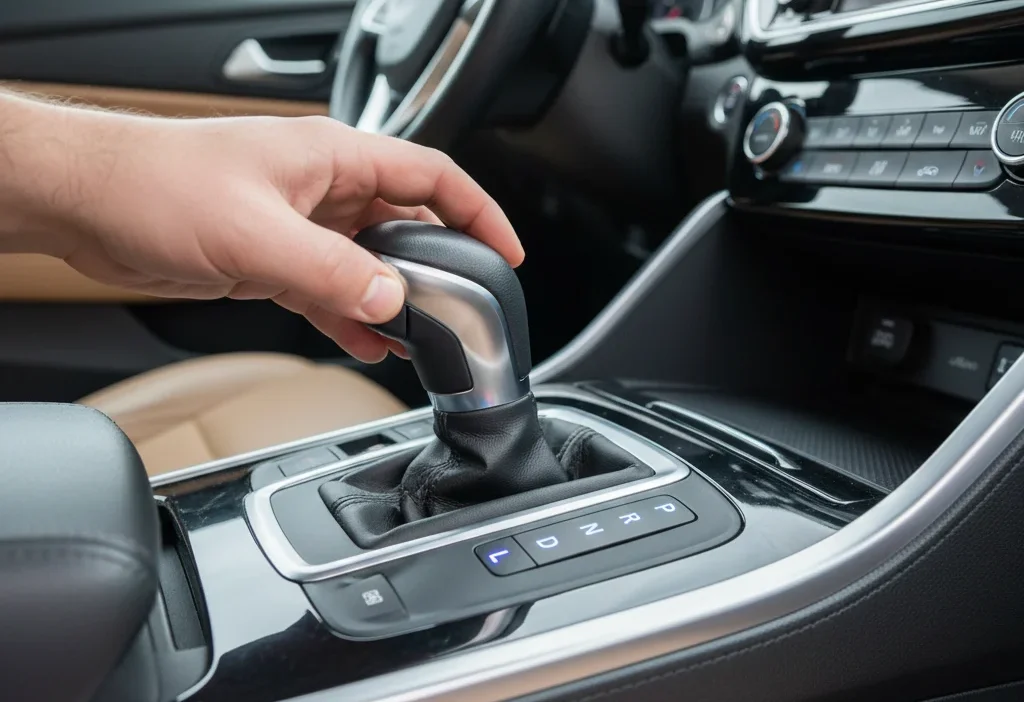
I’ll never forget the first time I drove my friend’s car. I was so used to my own simple setup that when I saw the “P-R-N-D-L” on his gear selector, I froze. “Drive” I knew. “Park” and “Reverse” were obvious. But “L”? My mind raced. Was it for “Ludicrous Speed”? “Launch Mode”? I was too embarrassed to ask and spent the whole drive carefully avoiding it, terrified of what might happen. If you’ve ever had that same moment of confusion, staring at that solitary “L” and wondering what secret driving mode you’re missing out on, you’re in the right place. Let’s demystify it together.
The “L” on a gear shift stands for “Low Gear.” It’s a functional setting used to limit the transmission to the lower gears, providing more engine power and engine braking at slower speeds, typically for driving down steep hills or towing heavy loads.
🧠 What Does the L Mean on a Gear Shift?
Simply put, the “L” on your gear selector is an abbreviation for “Low Gear” or “Low Mode.” In an automatic transmission, you don’t manually change gears like in a manual car; the car’s computer does it for you. When you shift into “Drive” (D), the transmission automatically cycles through all available gears, from 1st to 4th, 5th, 6th, 8th, or even 10th, depending on your car.
Selecting “L” tells the transmission to stay within a lower range of gears and not shift into the higher, overdrive gears. This might be limited to 1st and 2nd gear, or sometimes just 1st gear, depending on the vehicle.
Why would you want to do this? It comes down to power and control. Lower gears in any car provide more torque (wheel-turning power) and less speed. They also create a phenomenon known as “engine braking.” When you’re going downhill, gravity wants to pull your car faster and faster. In “Drive,” you’d have to ride the brakes constantly, which can overheat them and cause “brake fade”—a dangerous loss of braking power. In “L,” the engine itself helps slow the car down without you needing to press the brake pedal as much, giving you much better control.
In short: L = Low Gear = More power, more control, less speed.
📱 Where Is the L Gear Commonly Used?
The “L” setting isn’t for your daily commute on flat highways. It’s a specialized tool for specific driving conditions. You’ll find it on most automatic transmissions, from sedans to SUVs and trucks.
You’ll primarily use “L” in these scenarios:
- 🚙 Driving Down Steep Hills: To prevent your brakes from overheating and maintain a safe, controlled descent.
- 🚚 Towing a Trailer or Heavy Load: To provide more consistent power and reduce strain on the transmission when going up or down an incline.
- 🪨 Driving Up Very Steep Inclines: To ensure the transmission doesn’t “hunt” for gears and provides steady, low-end power.
- 🌧️ Driving in Deep Mud, Sand, or Snow: At very slow speeds, using a low gear can help provide smooth, consistent torque without spinning the wheels, which can help you “crawl” out of a tricky situation.
Is it for casual use? No, “L” is a functional setting for specific challenges. It’s not something you use in everyday driving on flat roads.
💬 Examples of Using the L Gear in Real Driving Situations
Let’s paint a picture of when you’d actually move that shifter into “L.”
Scenario 1: Descending a Mountain Pass
- You: (Driving down a long, steep mountain road) “The brake pedal is feeling a bit soft and I smell something burning.”
- The Solution: You safely slow down, shift the gear selector from “D” to “L.” The engine RPMs jump up, and you immediately feel the car slow down. You can now take most of the pressure off the brakes, controlling your speed primarily with the engine.
Scenario 2: Towing a Boat Up a Ramp
- You: “I need to pull this heavy boat out of the water. In ‘Drive,’ the wheels are just spinning on the slick ramp.”
- The Solution: You come to a complete stop, shift into “L” before you start moving. This ensures you start in 1st gear, getting the maximum torque to pull the load steadily up the ramp without wheel spin.
Scenario 3: Crawling in Heavy Traffic on a Hill
- You: “This stop-and-go traffic on a steep San Francisco-style hill is a nightmare. I keep rolling back and forth between the brake and gas.”
- The Solution: Shifting into “L” allows the car to crawl at a very low speed using engine braking, making it easier to manage your speed and distance without constantly switching pedals.
Scenario 4: Navigating a Rough, Rocky Trail
- You: “I need to go over these rocks and ruts very slowly and carefully.”
- The Solution: “L” provides a slow, controlled “crawl” speed, giving you precise control without having to delicately balance the accelerator and brake.
🕓 When to Use and When Not to Use the L Gear
Knowing when not to use “L” is just as important as knowing when to use it.
✅ When to Use the L Gear
- When descending long, steep grades to save your brakes.
- When towing or carrying a very heavy load up or down a hill.
- When you need maximum low-speed power and control for off-road crawling or climbing.
- When navigating icy or very slippery slopes at a slow, controlled pace.
❌ When NOT to Use the L Gear
- Do NOT use it for normal driving on flat roads. It will make the engine rev excessively high, wasting fuel and causing unnecessary wear.
- Do NOT shift into “L” at high speeds. This can be very hard on your transmission and engine. If you need to use it, always slow down first.
- Do NOT use it as a substitute for your parking brake.
- Avoid using it for sudden deceleration or panic stops; your main brake pedal is always the right tool for that.
Here’s a quick-reference table to summarize:
| Context | Example Phrase | Why It Works |
|---|---|---|
| Steep Hill Descent | Shifting to “L” before starting the descent. | Provides engine braking, prevents brake fade, and increases safety. |
| Heavy Towing | Using “L” while pulling a trailer up a steep ramp. | Offers maximum torque and prevents gear “hunting” under load. |
| Normal Highway Driving | Keeping the shifter in “D” (Drive). | Allows for normal gear shifts, optimal fuel economy, and quiet operation. |
| High-Speed Driving | Using the brake pedal to slow down, not “L.” | Prevents severe damage to the transmission and engine. |
🔄 Similar Gear Shift Letters and Their Meanings
Your gear shift has other letters besides “L.” Understanding this “alphabet soup” helps you become a more informed and skilled driver.
| Slang | Meaning | When to Use |
|---|---|---|
| S | Sport Mode | For more responsive acceleration. The transmission holds gears longer and shifts at higher RPMs. |
| M | Manual Mode | Allows you to shift gears manually using the gear selector or paddle shifters, without a clutch. |
| 1 / 2 | First / Second Gear | Locks the transmission specifically in 1st or 2nd gear, offering even more specific control than “L.” |
| B | Engine Braking | Similar to “L,” often found in hybrids and EVs, it increases regenerative braking for downhill control. |
| 4L / 4LO | Four-Wheel Drive Low | A different system for serious off-roading; provides extreme low-speed torque for rock crawling. |
❓ FAQs About the L Gear
Can I shift from D to L while driving?
Yes, but only at low speeds. It’s best to do it when you are already going slowly, under 30-40 mph. Never force it into “L” when the engine is screaming in high RPMs.
What happens if I accidentally drive in L?
Your engine will rev very high, it will be loud, and you will waste a lot of gas. You won’t be able to achieve normal highway speeds. Simply shift back to “D” to return to normal driving.
Is the L gear the same as 1st gear in a manual?
Functionally, it’s very similar. “L” often uses 1st gear (and sometimes 2nd), replicating the high-torque, low-speed characteristics of a manual car in 1st gear.
Does using L gear hurt my car?
Using it for its intended purpose (slow-speed, high-power situations) will not hurt your car. However, using it at high speeds or for prolonged periods on flat roads can cause unnecessary strain.
Should I use L in snow?
It can be helpful for crawling at very slow, controlled speeds in deep snow, as it prevents the transmission from shifting up and potentially causing wheel spin. For most snowy roads, however, “Drive” is perfectly fine.
Conclusion
The “L” on your gear shift is no longer a mystery. It’s not for “Ludicrous Speed” or “Leisure,” but for the practical and highly useful “Low Gear.” It’s a powerful tool designed to give you, the driver, more control and safety in specific, demanding situations like steep hills and heavy towing. The next time you see that “L,” you can look at it with confidence, knowing exactly what it does and when to call upon its unique abilities. So, go forth and drive smarter, not harder

Hiromi Kawakami is a contemporary dream analyst and spiritual writer who explores the intersection of everyday life and dream symbolism. Her approach blends gentle observation with mystical insight, guiding readers to understand the spiritual significance of their dreams. Hiromi encourages self-reflection through the subtle messages of the subconscious.