I’ll never forget the first time I saw the word “perpendicular” in my 8th-grade geometry class. My teacher was drawing lines on the board, talking about right angles, and this long, intimidating word kept popping up. I remember thinking, “That sounds so complicated! Is this just a fancy word for lines that cross?” I was too shy to ask, and I spent the next week feeling a little lost. If you’ve ever felt that same confusion, you’re in the right place. Let’s break down this fundamental math concept into something simple and relatable.
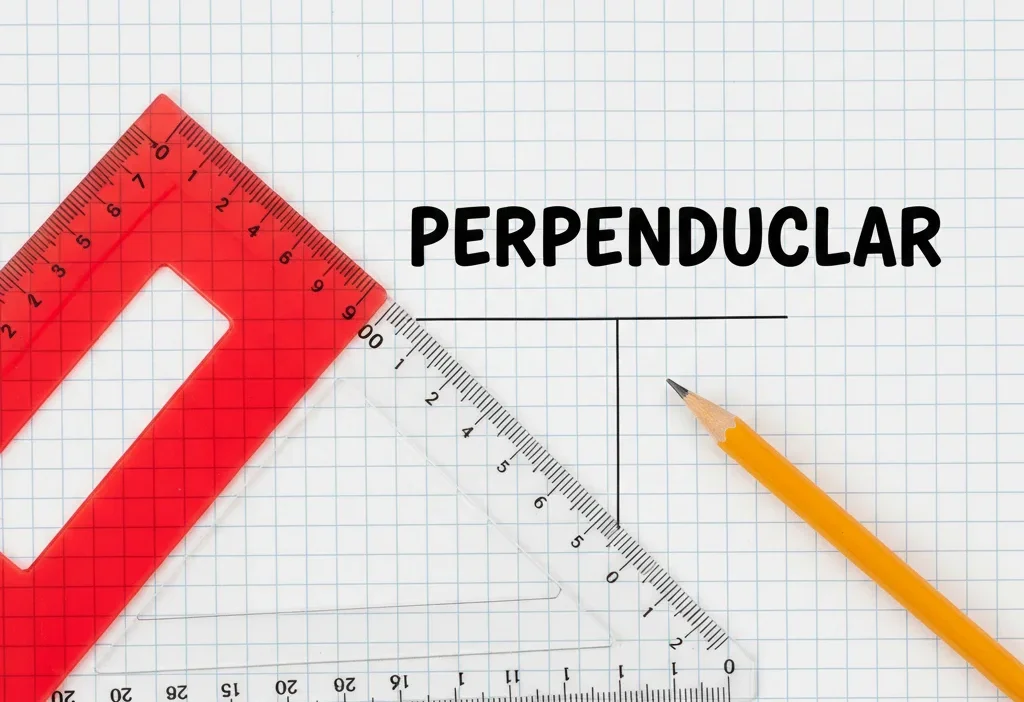
In math, “perpendicular” describes a special relationship between two lines, segments, or surfaces that meet at a perfect 90-degree angle, also known as a right angle. It’s a precise way of saying two things meet in a perfect “L” or “T” shape, forming a corner that is exactly square.
✨ What Does Perpendicular Mean in Math?
At its heart, “perpendicular” is a geometric term that describes a very specific type of intersection. When we say two lines are perpendicular, it means they cross each other in such a way that they create four angles of exactly 90 degrees each. Imagine the corner of a piece of paper, the letter “T,” or the plus sign “+”. These are all perfect examples of perpendicular lines meeting.
The key here is the 90-degree angle. This isn’t about lines that are just “kind of” at a corner; it’s a precise, mathematical definition. The point where they intersect is called the foot of the perpendicular.
In short: Perpendicular = Meeting at a 90° Angle = A Perfect “L” Shape.
📐 The Symbol and Notation of Perpendicular
In the written language of mathematics, we don’t always want to spell out the full word “perpendicular.” That’s where symbols come in! The symbol for perpendicular is ⟂.
You would write this relationship between two lines, say Line AB and Line CD, as: AB ⟂ CD
This is read as: “Line AB is perpendicular to Line CD.” Seeing this symbol is a quick, universal way to know that the two lines in question form that crucial right angle. It’s the math world’s shorthand for a perfect corner.
🧠 How to Identify Perpendicular Lines
So, how can you tell if lines are truly perpendicular? You can’t just eyeball it! In geometry, accuracy is everything. Here are the primary ways to identify perpendicularity:
- Using a Protractor: This is the most direct method. Place the center of your protractor on the point where the two lines intersect. If the angle between them measures exactly 90 degrees, they are perpendicular.
- Using a Right Angle Tool: Many set squares (or triangle rulers) have a 90-degree corner. You can place this corner at the intersection point to see if the lines align perfectly with the tool’s edges.
- The Slope Method (For Algebra): If you’re working with lines on a graph, you can use their slopes. Two lines are perpendicular if the product (multiplication) of their slopes is -1. For example, if one line has a slope of 2, a line perpendicular to it will have a slope of -1/2.
📱 Where Do We See Perpendicularity in the Real World?
Geometry isn’t just for textbooks! The concept of perpendicularity is absolutely everywhere in our daily lives, providing stability, structure, and order. Once you start looking for it, you’ll see it all around you.
- 🏗️ Architecture & Construction: Buildings rely on perpendicularity to stand upright. Walls are built perpendicular to the floor, and window and door frames are perfect rectangles made of perpendicular lines. Without this, structures would be unstable and leaning.
- 🪑 Furniture: The legs of a chair or table are perpendicular to the seat and the floor. The corners of your desk, your phone, and your TV screen are all 90-degree angles.
- ➕ Roadways: Street intersections are often designed to be perpendicular. A classic four-way stop is a great example of two roads crossing at right angles. The center lines on a road are perpendicular to the lane dividers at crosswalks.
- 🎨 Design & Art: Graphic designers use perpendicular guides to align elements on a website or poster, creating a clean, balanced layout. The grid system in photography often uses perpendicular lines to help compose a shot.
💬 Perpendicular vs. Parallel: What’s the Difference?
This is a common point of confusion, but it’s a crucial distinction. Let’s clear it up.
- Parallel Lines: These are lines in a plane that never meet. They are always the same distance apart, like train tracks or the double lines on a highway. Think “side-by-side, forever.”
- Perpendicular Lines: These are lines that do meet, and they meet at one specific point, forming a 90-degree angle. Think “intersecting to form a perfect corner.”
In short: Parallel lines run together without touching, while perpendicular lines meet to create a square corner.
📐 Examples of Perpendicular Lines in Geometry Problems
Let’s look at how perpendicularity might appear in a typical math class context.
- The Coordinate Plane:
- The x-axis and y-axis on a graph are the most classic examples of perpendicular lines. They intersect at the origin (0,0) and create four 90-degree angles.
- Shapes:
- Squares and Rectangles: Every adjacent side (sides that meet) in a square or rectangle is perpendicular. This is what gives them their sharp, square corners.
- Right Triangles: A right triangle is defined by having one 90-degree angle. The two sides that form this right angle are perpendicular to each other.
🕓 When to Use and When Not to Use the Term “Perpendicular”
Knowing the right context for this term is key to using it correctly.
✅ When to Use “Perpendicular”
- In a Math or Geometry Class: This is the primary and most appropriate context.
- In Technical Fields: When discussing blueprints, engineering designs, architectural plans, or computer-aided design (CAD).
- When Precise Communication is Needed: If you’re giving instructions to a builder or designer and need to specify an exact 90-degree angle, “perpendicular” is the correct and unambiguous term.
❌ When Not to Use “Perpendicular”
- In Casual, Everyday Conversation: You wouldn’t typically say, “Please place the picture frame perpendicular to the table.” You’d just say, “Hang it straight,” or “Make sure it’s square.”
- When Describing Approximate Angles: If something is close to a right angle but not exact, it’s better to say “roughly a right angle” or “almost square.” Perpendicular implies precision.
Here’s a quick comparison table for clarity:
| Context | Example Phrase | Why It Works |
|---|---|---|
| Geometry Class | “Prove that line AB is perpendicular to line CD.” | Technically precise and expected in an academic setting. |
| Telling a Friend | “Can you hold the poster straight?” | Casual, relatable, and gets the point across without jargon. |
| Giving Instructions to a Carpenter | “The shelf needs to be perpendicular to the wall.” | Clear, professional, and leaves no room for error. |
🔄 Similar Geometric Relationships
“Perpendicular” is one of several key terms used to describe how lines relate to each other. Here are some important alternatives and how they differ.
| Term | Meaning | When to Use |
|---|---|---|
| Parallel | Lines that never intersect and are always equidistant. | Describing lines that run in the same direction without meeting, like train tracks. |
| Intersecting | Lines that cross each other at any angle. | The general term for any two lines that meet. (All perpendicular lines intersect, but not all intersecting lines are perpendicular). |
| Oblique | Lines that intersect at any angle that is not 90 degrees. | Describing lines that cross but are slanted and do not form a right angle. |
| Skew | Lines that are not parallel and do not intersect because they are in different planes. | Describing lines in 3D space that are not aligned and will never meet (e.g., a line on the ceiling and a line on the floor). |
❓ FAQs About Perpendicular Lines
Q: Can curves be perpendicular?
A: Yes! A line can be perpendicular to a curve. At the specific point where they touch, the line (called a tangent) forms a 90-degree angle with the curve’s radius at that point.
Q: What is the difference between perpendicular and vertical/horizontal?
A: Vertical and horizontal are specific directions (up-down and left-right). Perpendicular is about the relationship between two things. A vertical line is always perpendicular to a horizontal line, but two diagonal lines can also be perpendicular to each other if they cross at a 90-degree angle.
Q: Are all intersecting lines perpendicular?
A: No, this is a common misconception. Perpendicular lines are a special type of intersecting line. Lines can intersect at many different angles (30°, 45°, 80°), but they are only called perpendicular if they intersect exactly at 90°.
Q: How many times can two lines be perpendicular?
A: In a standard plane, two lines can only be perpendicular once, at a single intersection point.
📝 Conclusion
So, the next time you see the word “perpendicular,” you don’t have to feel that old sense of confusion. It’s not a complicated, fancy term designed to trick you. It’s simply the mathematical way of describing a perfect, 90-degree corner—one of the most fundamental and stable shapes in our universe. From the buildings we live in to the screens we’re reading this on, perpendicularity provides the hidden framework that makes our world structured and solid. Now that you’re in the know, you’ll start seeing these perfect right angles everywhere

Tove Jansson is a writer and dream interpreter with a deep fascination for the symbolic world of the subconscious. She explores how everyday experiences manifest in dreams, blending creativity with spiritual insights. Tove believes that every dream carries a hidden message meant to guide personal growth and self-discovery.