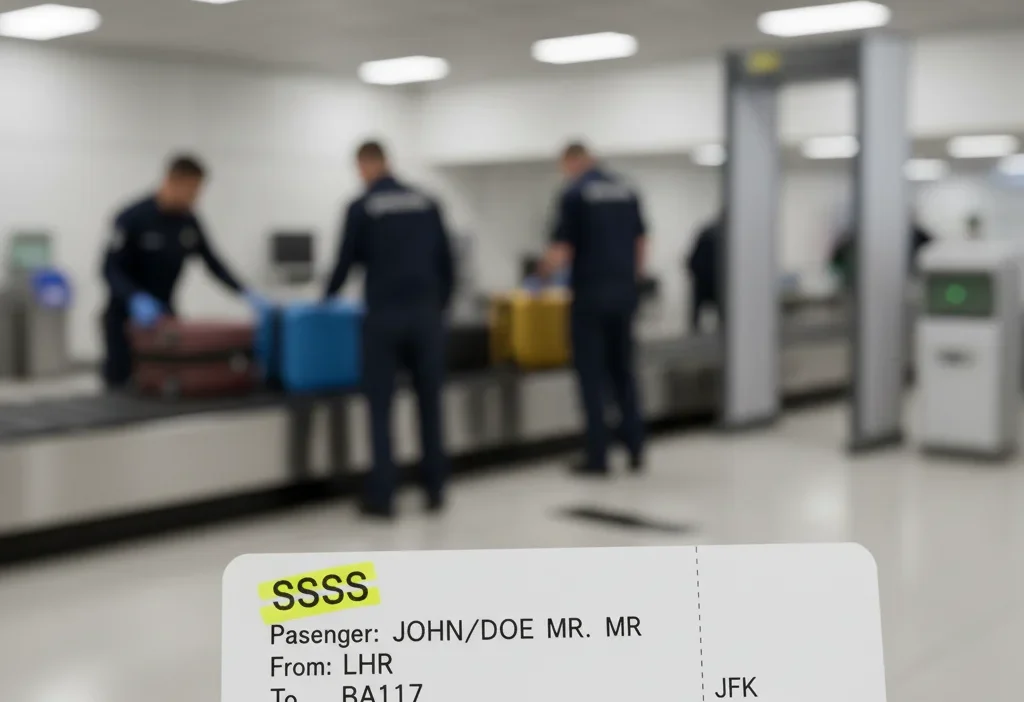
If you’ve ever checked in for a flight, glanced at your boarding pass, and suddenly noticed the mysterious letters “SSSS” on it, you’re not alone. Many travelers panic the first time they see it — I did too! It looked like some secret airline code, and for a moment, I thought I was in trouble or had done something wrong. But don’t worry — it’s more common than you think.
Before we dive deep, here’s the quick answer:
SSSS stands for Secondary Security Screening Selection. It means you’ve been selected for additional security checks at the airport before boarding.
🧠 : What Does SSSS Mean on a Boarding Pass?
SSSS is an official TSA (Transportation Security Administration) code printed on some boarding passes.
It stands for:
✔️ Secondary Security Screening Selection
If “SSSS” appears on your boarding pass, it means you’ll undergo extra security steps such as:
- Additional bag checks
- Pat-downs
- Explosive residue screening
- Detailed questioning
- Manual inspection of electronics
This process usually happens at the gate before boarding international flights.
Example:
“My boarding pass had SSSS on it, so I had to go through an extra security check before getting on the plane.”
In short: SSSS = Extra airport security = Extended screening before boarding.
📱 Where Is SSSS Commonly Seen?
You’ll find “SSSS” specifically on:
- ✈️ Boarding passes for international flights
- 🛂 Flights entering the United States
- 🧳 Randomly selected passengers
- 🌍 Travelers who trigger certain security patterns
- 🧾 Both printed and mobile boarding passes
Is it casual or formal?
This is formal airport security terminology, not slang or text language.
💬 Examples of SSSS in Real Travel Situations
Here are realistic scenarios showing how “SSSS” is used:
1.
A: “Bro, my boarding pass says SSSS. Should I worry?”
B: “Nah, it’s just extra security screening. Happens sometimes.”
2.
A: “Why did they pull me aside at the gate?”
B: “Probably SSSS on your pass.”
3.
A: “They opened all my bags because of SSSS 😩”
B: “Yeah, that’s normal for that code.”
4.
A: “I missed my coffee run because SSSS took forever.”
B: “Oof, bad luck. It’s random.”
5.
A: “My friend didn’t get SSSS but I did.”
B: “It’s different for everyone — nothing personal.”
6.
A: “Is SSSS dangerous?”
B: “Nope, just extra checks.”
7.
A: “They scanned my laptop twice.”
B: “That’s the SSSS procedure.”
🕓 When You Might Receive SSSS
You may get selected for SSSS if:
- You booked a one-way ticket
- You bought a ticket last minute
- Your travel route is considered high-risk
- You paid in cash
- Your name matches an alert list
- Your travel pattern is unusual
- You are selected randomly
⛔ Does SSSS Mean You’re in Trouble?
No.
SSSS does not mean you’re guilty of anything, under investigation, or doing something wrong. It is:
- Routine
- Random
- Standard procedure
It simply ensures enhanced security for certain passengers.
📝 What Happens During SSSS Screening?
Expect the following:
- Your boarding pass is scanned
- You’re directed to a separate security area
- Bags are opened and inspected
- Electronic devices are checked
- You may get a pat-down
- You may be asked travel-related questions
- Your boarding pass receives a special stamp
The whole process takes 10–30 minutes.
⏳ When to Worry & When Not to Worry
✅ You SHOULD NOT Worry If:
- You were randomly selected
- You booked a last-minute international flight
- You have nothing to hide
❌ You Should Be Concerned ONLY If:
- You repeatedly get SSSS on every flight (possible red-flag listing)
- Your travel document is inconsistent
- There’s a visa or passport issue
If SSSS happens every single time, you can submit a DHS TRIP inquiry.
📊 Comparison Table: When SSSS Appears & What It Means
| Situation | Example | Why It Happens |
|---|---|---|
| Random selection | You check in normally and see SSSS | Routine screening |
| One-way ticket | You’re traveling without a return | Security protocol |
| Last-minute travel | Same-day booking | Higher-risk pattern |
| Unusual route | Multi-country quick trips | Manual review |
| Name similarity | Similar to another person | System flag |
🔄 Similar Travel Security Codes (Table)
| Code | Meaning | When It Appears |
|---|---|---|
| SSSS | Extra security screening | Before boarding |
| TSA Pre | Expedited screening | For trusted travelers |
| T-Flag | Identity alert | Passport/ID issues |
| Quad S | Same as SSSS | International flights |
| DOCS OK | Document approved | Check-in validation |
| ETKT | Electronic Ticket | Standard notation |
🌍 Why Does the System Select You for SSSS?
Automated security algorithms use:
- Travel history
- Ticket pattern
- Document validation
- Random selection
- Behavioral triggers
Most cases are simply random.
🧾 Can You Avoid SSSS?
Yes — sometimes.
Ways to reduce the chances:
- Use the same travel route consistently
- Avoid last-minute one-way bookings
- Join Trusted Traveler Programs
- Ensure passport data always matches airline records
- Avoid suspicious booking patterns
❓ FAQs
1. Is SSSS dangerous?
No. It’s a standard airport security step.
2. How long does SSSS take?
Usually 10–30 minutes.
3. Can I refuse SSSS?
No. You cannot board without completing it.
4. Does SSSS mean I’m suspected of something?
Absolutely not.
5. Does SSSS happen on domestic flights?
Very rarely — mostly international.
6. Is SSSS printed on mobile boarding passes?
Yes, it appears digitally too.
7. Why do I get SSSS every time?
You may be incorrectly flagged; submit a DHS TRIP request.
🟢 Conclusion
Seeing SSSS on your boarding pass can be confusing, but it’s nothing to stress about. It simply means you’ve been chosen for additional airport security screening, usually for random or technical reasons. The process is straightforward, takes a bit of extra time, and doesn’t imply wrongdoing. Understanding what SSSS means helps you stay prepared, calm, and confident the next time you fly.
Hiromi Kawakami is a contemporary dream analyst and spiritual writer who explores the intersection of everyday life and dream symbolism. Her approach blends gentle observation with mystical insight, guiding readers to understand the spiritual significance of their dreams. Hiromi encourages self-reflection through the subtle messages of the subconscious.