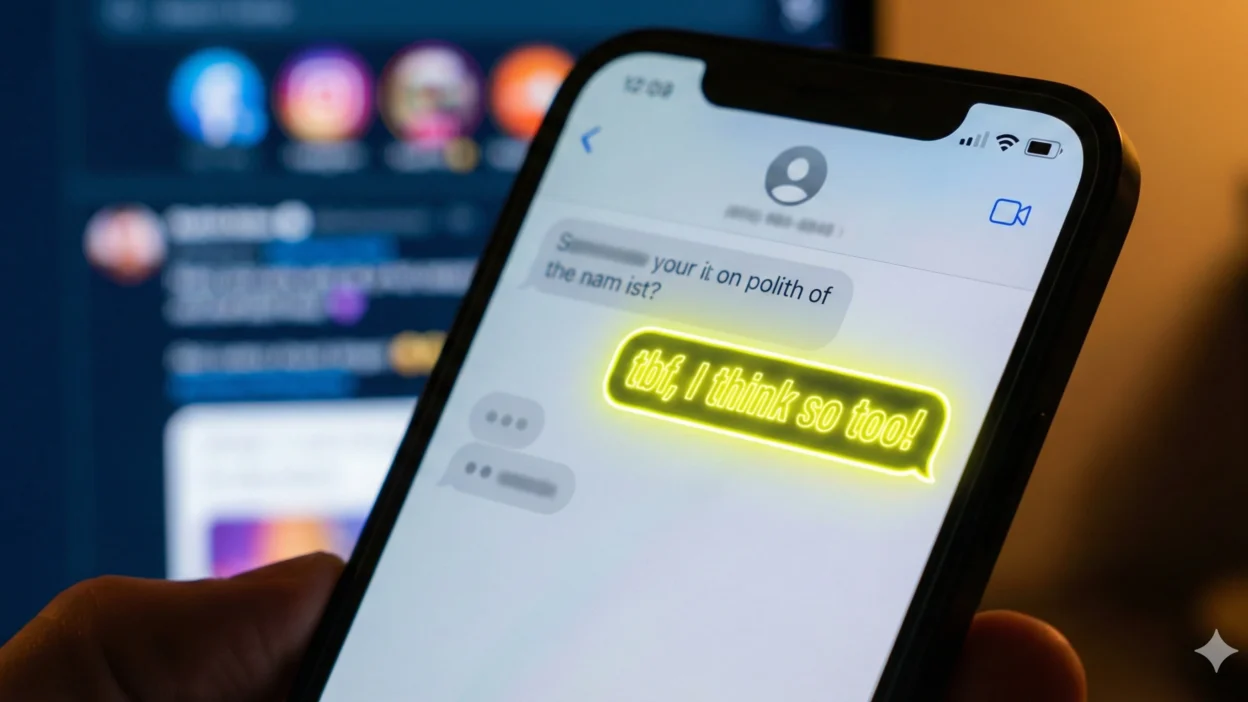
TBF means “To Be Fair.” It’s a friendly, conversational way of introducing a balanced perspective, acknowledging a counterpoint, or softening a critique in casual text and online chats.
You’re scrolling through a group chat, following a rapid-fire debate about the best pizza topping (pineapple, obviously 🍍), when you see it: “tbf, pineapple does add a sweet contrast.” You pause. TBF? Your brain races through possibilities. “True Best Friend”? “Totally Bizarre Fact”? If you’ve ever felt that moment of slang-induced confusion, you’re not alone. The digital lexicon evolves faster than a viral TikTok trend, and keeping up can feel like decoding a secret language. One minute you’re fluent in “FR” and “ICYMI,” the next you’re hit with a new acronym. Today, we’re cracking the code on TBF. Let’s dive into what it really means, where it came from, and how to use it without a second thought.
🧠 What Does TBF Mean in Text?
At its core, TBF is an acronym for the phrase “To Be Fair.” It’s a staple of informal digital communication used to introduce a point that adds balance, fairness, or a different angle to a discussion. Think of it as the text equivalent of holding up a hand and saying, “Okay, wait, let’s look at it from this side.
It serves a few key purposes:
- To Present a Balanced View: It prefaces a statement that acknowledges the other side of an argument.
- To Soften Criticism: It can make a critique or correction sound more polite and reasonable.
- To Admit a Counterpoint: It’s often used when you’re agreeing with someone but have a slight caveat to add.
Example in action: “I didn’t love the movie’s ending. TBF, the special effects were incredible.”
In short: TBF = To Be Fair = A way to introduce a fair or balancing point.
📱 Where Is TBF Commonly Used?
TBF thrives in any digital space where casual, rapid conversation happens. You’ll spot it most often in:
- 💬 Texting & Messaging Apps (iMessage, WhatsApp): For debates, planning, or everyday chats with friends.
- 🐦 Social Media (Twitter/X, Reddit, TikTok Comments): Perfect for threaded discussions, debates, and adding nuance to hot takes.
- 🎮 Online Gaming Chats (Discord, in-game comms): Used during post-game analysis or team strategy talks. (“We played badly. Tbf, our healer disconnected.”)
- 💼 Casual Workplace Chats (Slack, Teams – in appropriate channels): Can be used for light-hearted team discussions, but not for formal client communication.
Tone & Formality: TBF is decidedly casual and conversational. It’s social-media–friendly and perfect for talking with peers, but it doesn’t belong in formal essays, official reports, or serious customer-service emails.
💬 Examples of TBF in Conversation
Here’s how TBF flows in real, relatable chats:
- In a Debate:A: This new album is their worst work ever.
B: It’s definitely different. tbf though, the production quality is next level. - Making Plans:A: Jamie is always 20 minutes late, it’s so annoying.
B: I know 😤 tbf, the bus line to their place is super unreliable. - Giving Softened Feedback:A: Here’s my draft of the presentation slides.
B: The content is great! Tbf, the font might be a little hard to read from the back. - On Social Media:Tweet: The director ruined this adaptation. Nothing like the book!
Reply: I get the disappointment. TBF, fitting a 500-page novel into a 2-hour movie is impossible. - Self-Reflection:A: Ugh, I completely bombed that job interview.
B: Don’t be so hard on yourself! Tbf, you said they asked some really weird questions.
🕓 When to Use and When Not to Use TBF
✅ When TO Use TBF:
- In casual chats with friends and family.
- On social media to add nuance to your opinion.
- In relaxed team chats to politely introduce another perspective.
- When you want to sound reasonable and balanced, not confrontational.
❌ When NOT to Use TBF:
- In formal academic or business writing.
- In urgent messages where clarity is critical (e.g., “Call 911!” not “Tbf, you should call 911”).
- In sensitive situations where it might seem like you’re downplaying someone’s feelings.
- In official complaints or legal correspondence.
| Context | Example Phrase | Why It Works / Doesn’t Work |
|---|---|---|
| Friend Chat | “That cafe was overpriced. tbf, the coffee was amazing.” | Perfectly casual and adds a balanced take. |
| Work Chat (Casual) | “The meeting ran long. Tbf, we did resolve the big issue.” | Appropriate for a casual post-meeting debrief with colleagues. |
| Formal Email | “To be fair, the quarterly projections were optimistic.” | Use the full phrase “To be fair,” not the acronym TBF. The acronym is too informal for this setting. |
🔄 Similar Slang Words or Alternatives
TBF is part of a family of acronyms used to frame your thoughts quickly. Here are some cousins in the slang dictionary:
| Slang | Meaning | When to Use It |
|---|---|---|
| TBH | To Be Honest | When stating a frank or personal opinion. |
| NGL | Not Gonna Lie | Similar to TBH, but often for admitting something surprising or slightly awkward. |
| IMO/IMHO | In My Opinion / In My Humble Opinion | To preface a subjective take, often online. |
| FR | For Real | To emphasize you are being sincere or express strong agreement. |
| Lowkey | Secretly / Kind of / To a mild degree | To describe a subtle feeling or a private opinion. |
❓ FAQs About TBF
Is TBF rude?
Not at all! When used correctly, TBF is actually a polite and considerate way to introduce a different viewpoint. It shows you’re trying to be fair and balanced.
What’s the difference between TBF and TBH?
This is a key distinction! TBH (To Be Honest) is about stating your personal, frank opinion. TBF (To Be Fair) is about acknowledging an objective fact or perspective that balances the discussion.
- TBH Example: “tbh, I didn’t really enjoy the party.“
- TBF Example: “tbf, the party was in a pretty hard-to-find location.“
Can I use TBF at work?
Use caution. In very casual internal chats (like a non-work-related Slack channel), it’s fine. However, in emails to clients, formal reports, or official presentations, always write out the full phrase “to be fair.” The acronym is too informal for professional contexts.
How do I pronounce TBF?
Simply say each letter: “Tee-Bee-Eff.” People rarely say the full phrase “to be fair” out loud when using the acronym.
Conclusion
So, the next time you see “tbf” pop up in your messages, you won’t skip a beat. You’ll understand it’s someone trying to level the playing field, add a sprinkle of nuance, or simply be a bit more considerate in a digital conversation that often leans toward the black-and-white. It’s a small acronym that carries a powerful social function: promoting fairness and balanced thinking in our fast-paced chats. Now that you’re equipped with its meaning, examples, and etiquette, you can confidently weave TBF into your own texts and posts. Go ahead—be fair, be balanced, and text on! 😉

Silvina Ocampo is a spiritual writer and analyst of dream symbolism. With a background in literature and mystical studies, she uncovers the deeper meanings behind dreams and their connection to the human psyche. Silvina’s writings invite readers to explore the hidden layers of their dreams and awaken their inner wisdom.